
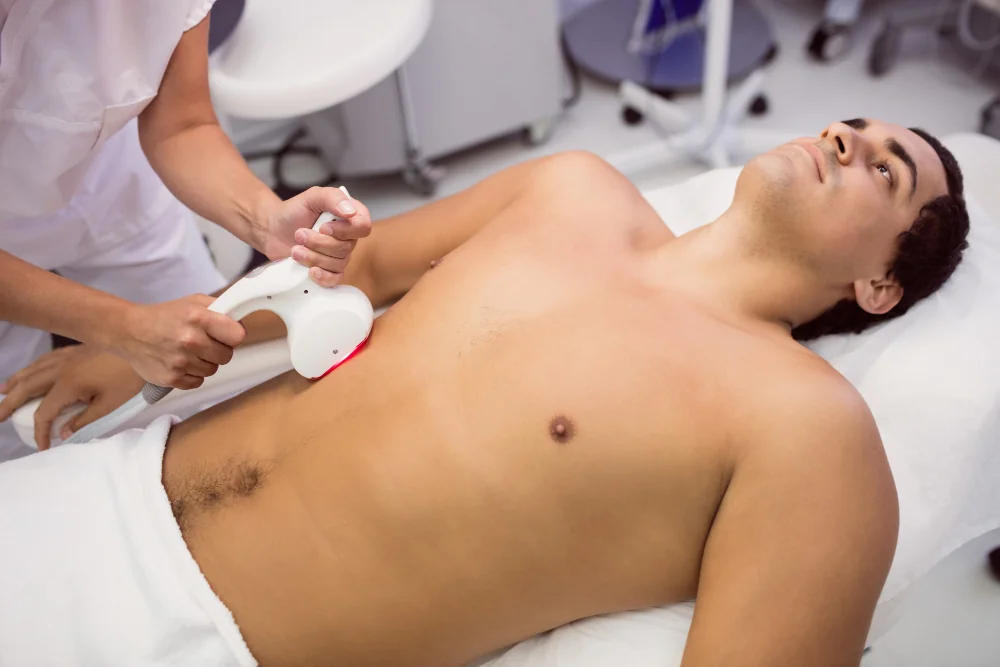
Laser Hair Removal for Men
Everything about laser in the men's section — devices, areas, preparation and realistic results.
Laser hair removal for men is not a single service but a set of options that differ by area and coverage, all meeting at one point: the device is chosen after your skin tone is assessed, never before.
This page brings together everything you need before booking: how laser works, which device suits you, what the options are, and what to do before and after a session.
What is the problem?
Dense hair across the back, chest and shoulders that you cannot reach with a razor on your own — and when you do, it returns within two days coarser than before.
An uneven beard line that needs tidying every day or two, and hair creeping down the neck outside the line.
Irritation after shaving, and hair growing back under the skin leaving inflamed bumps where the skin rubs.
The alternatives are familiar and tiring: waxing hurts and lasts weeks, plucking leaves inflammation, and repeated shaving causes redness and spots.
How does laser work?
A pulse of light is absorbed by the pigment in the hair and converted into heat, which progressively weakens the follicle until it stops producing.
This is why it works on dark hair, and why white, grey and very light blonde hair does not respond — it lacks sufficient pigment.
And the closer the skin colour is to the hair colour, the smaller the difference between them, and the more a different device and wavelength are needed. This is why establishing skin tone comes before everything else.

Which device suits your skin?
| Device | Type | Suited to |
|---|---|---|
| GentleMax Pro | Dual wavelength 755 + 1064 | All skin tones including the darker end |
| GentleLase Pro | 755 wavelength | Fair to medium skin |
| Lutronic eCO2 | Fractional | Scars and resurfacing — not hair removal |
| Spectra | Q-switched | Tattoo and pigmentation — not hair removal |
Your skin tone is established at the first appointment using a recognised medical scale and recorded in your file with its date, so it is not re-estimated at every visit and does not vary with whoever is treating you.
The options for men
Full body
Covers the body areas in a single appointment rather than spreading them across separate visits. The list of areas included is confirmed with you before the session begins.
Mini body
Fewer areas and a shorter slot. The difference is not in the quality of the session or the device — only in the number of areas.
Single areas
Back · chest · shoulders · neck · underarms · arms · legs. Classified as small or large, and the classification determines the time allocated to your appointment.
Beard and jawline shaping
A service in its own right with its own page, because the decision is different: we draw the beard line and agree it before the first pulse.
Intimate area
Performed exclusively by a male technician in a closed room, with its own page covering the procedure and privacy in full.
Before and after a session
Two weeks before: no plucking, waxing or threading, and avoid heavy sun exposure or tanning.
The day before: shave the area with a razor down to skin level.
On the day: arrive with the area clean and dry, with no creams, oils or deodorant on it.
Tell us about any medication you take and any change in your skin since your last visit.
After the session: cooling and a gentle moisturiser, and avoid steam, sauna, the gym and very hot showers for one to two days.
After the session: sunscreen on exposed areas, and avoid direct sun.
Between sessions: shaving with a razor is allowed at any time. Plucking and waxing are not.
The single biggest cause of a weak result
Laser targets the hair and its root, and plucking and waxing pull that root out of place.
So when the next session comes, the device finds no target to work on — and the whole session is wasted while you assume the device did not work.
Shaving with a razor does not do this, which is why it is the only method allowed between sessions.
What we tell you before you pay
Laser reduces and progressively weakens hair — we do not promise complete permanent removal, and we do not give a session count before seeing your hair.
White, grey and light blonde hair does not respond, and we will not sell you sessions on an area we know will not respond.
The result accumulates across spaced sessions. Judging it after the first session is judging at the wrong moment.
What is not said in many clinics
We have one dual-wavelength device.
If your skin is at the darker end of the range, your appointment depends on that specific device being available — and we may reschedule you rather than run you on a device that does not suit your skin.
We tell you this in advance because the alternative is being treated on an unsuitable device and paying for it with your skin rather than your invoice.
When a session is postponed
- A recent tan or heavy sun exposure in the preceding days, and self-tanning products.
- Inflammation, a wound or inflamed spots in the area.
- Certain dermatological medications that increase the skin's sensitivity to light — tell us everything you are taking, as some require stopping for a period beforehand.
- A tattoo within the treatment area — the laser pulse does not pass over a tattoo, so the area is excluded or the plan is rearranged.
Call us if any of these occur
- Blistering or ulceration in the treated area.
- Persistent pain or severe redness lasting beyond two days.
- A clear change in skin colour — lighter or darker — that persists after the session.
Questions and answers
Questions men repeatedly ask about laser hair removal at Hokamaa Najd.
It varies with hair density, colour and thickness, and with the area itself. An estimate is given after assessment; we do not quote a number before seeing the case.
A quick sting with simultaneous cooling. Areas differ in sensitivity, the intimate area most of all, and settings are adjusted accordingly.
Yes, provided the appropriate wavelength is used. We have a dual-wavelength device for this, and your skin tone is established at the first appointment.
Laser reduces hair permanently but does not remove it entirely. What regrows is finer, lighter and slower, and you may need a maintenance session from time to time.
No — it has its own page, because the decision is different: we draw the line, agree it and photograph it before the first pulse.
A male technician. Intimate area sessions are performed by no one else under any circumstances, and have their own page.
It begins to shed gradually over the days following the session. This is expected — leave it rather than pulling it.
Tell reception as soon as you arrive. Long hair on the skin's surface reduces the session's effectiveness and increases the chance of irritation, and the appointment may be postponed.
It is best to wait a day or two, since sweat and friction on irritated skin increase inflammation.
Reducing hair in the area usually reduces ingrown hair and shaving irritation. Existing inflamed bumps are assessed first and may need treatment before sessions begin.
Yes, in most cases. Tell reception about both areas when booking, not on arrival, so the right amount of time is reserved.
No. A delay may slow progress but it does not erase the effect of previous sessions. Tell us the actual gap so the plan can be adjusted.
Book an assessment appointment — we establish your skin tone, the right device and the areas before any session.
Book an Assessment