

Male Infertility — When Should Testing Begin?
Testing the man is faster, simpler and cheaper — and often the right place to start.
A year of trying with no pregnancy? Male infertility is not rare — a male factor contributes to roughly half of all cases of delayed conception.
The good news is that testing the man is faster, simpler and cheaper than testing the woman: a clinical exam and a single test usually point the way.
At the urology and men's health clinic, we start from the cause: we pinpoint exactly where the problem lies before anything is prescribed.
Delayed Pregnancy — When Is the Cause on the Man's Side?
Many couples wait a long time before asking, and when they finally do, the wife alone begins the testing. This order wastes time for no reason.
The accepted medical threshold: if a full year of regular, unprotected intercourse has passed without pregnancy, it is time to assess both partners together — not the wife first and the husband two years later.
This threshold drops to six months if the wife is over 35, or if the man has a known risk factor such as a prior testicular operation or an obvious varicocele.
A Number Worth Reading Twice
A male factor is present in roughly half of delayed-conception cases, and in some of these it is the sole cause. Yet testing the man — the cheaper and faster step — is often the last thing requested.
Delayed Conception or Male Infertility?
You will meet both terms everywhere, and the word "infertility" specifically worries many people. In truth, they describe the same situation:
Male infertility
A medical term describing the absence of pregnancy after a year of regular attempts. It describes a present state, not a verdict on the future.
Delayed conception
The more accurate description of what most of our patients experience: an identifiable problem, much of which is correctable.
That is why this page uses the term "delayed conception." It is not a softer word choice — most of what we see in clinic is not an absence of fertility, but a cause nobody has looked for yet.
When Not to Wait a Full Year
See a doctor now, without delay, if any of the following applies to you:
Your wife is over 35 — the step begins at six months, not twelve.
You have had a prior testicular or hernia operation, or an undescended testicle in childhood.
You had mumps after puberty.
You use, or have used, testosterone injections or bodybuilding supplements.
You notice one or both testicles are smaller than expected, or feel prominent veins over a testicle.
A previous semen analysis was abnormal and was never followed up.
You have difficulty with intercourse or ejaculation that prevents semen from being delivered.
Two Signs That Don't Wait for an Appointment at All
- A firm, painless lump inside the testicle — examine it immediately; it may not even be related to fertility.
- Sudden, severe testicular pain — an emergency measured in hours, not a clinic appointment. The window for torsion is measured in hours.
Why Does Testing Usually Start With the Man?
Because assessing him is faster and cheaper, and three numbers are often enough to set the direction. Delaying it for two years, only to discover the cause was on his side, means two years taken from the wife's fertility window that cannot be recovered.
Causes of Delayed Conception in Men
- Varicocele
- Dilated veins that raise the temperature of the testicle, weakening production. The most common cause, and often correctable.
- Low sperm production
- A previously undescended testicle, mumps after puberty, genetic causes, or exposure to chemotherapy or radiation.
- Hormonal imbalance
- A disturbance in the fertility hormone axis: follicle-stimulating hormone, luteinizing hormone, testosterone, and prolactin.
- Blockage of the outflow tract
- Production inside the testicle is normal, but the pathway is blocked following a prior infection or operation. Among the most treatable causes.
- Testosterone injections and supplements
- Many assume they boost fertility; in fact they shut down sperm production. Tell your doctor about them directly — it is one of the first things asked about.
- Past infections
- Recurrent prostatitis or epididymitis can leave an effect on quality or on the tract.
- Lifestyle factors
- Smoking, obesity, uncontrolled diabetes, sustained heat exposure, and certain medications.
- A problem with performance or ejaculation
- Prevents semen from being delivered — an entirely different pathway from low sperm quality.
Varicocele — the Most Common Correctable Cause
A varicocele is a set of dilated veins inside the scrotum where blood pools, raising the testicle's temperature by a degree or more. The testicle is highly heat-sensitive: this small rise alone is enough to gradually weaken production.
A varicocele rarely presents as pain. Most men describe a heaviness or fullness in the testicle by day's end, or prominent veins felt on standing — and many feel nothing at all, discovering it only during a delayed-conception workup.
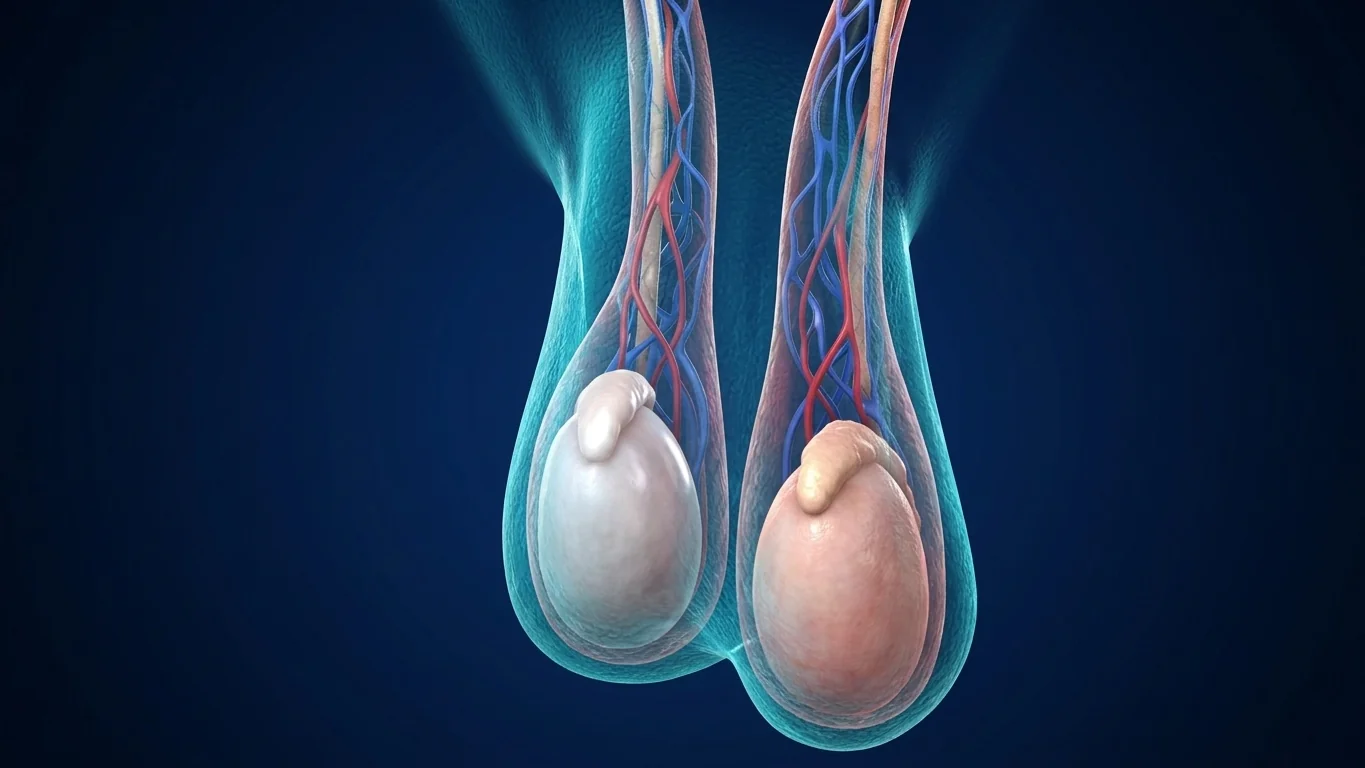
How do we document it?
With a clinical exam first, then a testicular vein and artery Doppler in-house. The Doppler measures vein width and any reverse blood flow — turning the doctor's impression into a number that can be tracked over time.
Does having a varicocele mean you won't father a child?
No. A significant proportion of men with a varicocele have fathered children without any intervention. A varicocele is assessed by its grade and its actual effect on the semen analysis — not as a verdict on its own. No decision about it is made before seeing the analysis.
Low Sperm Quality — What Does Your Result Actually Mean?
Many men leave with a report full of numbers and unfamiliar terms, understanding only the word "low." These are the four most important fields on it:
- Count / concentration
- How many sperm per millilitre. When low, it is called: oligozoospermia (low sperm count).
- Motility
- The proportion that move, and specifically move forward. When low, it is called: asthenozoospermia (poor sperm motility).
- Morphology
- The proportion with a normal shape. When low, it is called: teratozoospermia (abnormal sperm shape).
- Volume
- The amount of semen in the sample. When low, it is called: low semen volume.
A fourth condition is noted separately: azoospermia — a complete absence of sperm in the sample. It is not the dead end it is often assumed to be, because the real question is: has production inside the testicle stopped, or is production normal with a blocked outflow? The two are entirely different pathways, and specific tests distinguish between them.
A Rule That Eases a Lot of Worry
Semen analysis numbers are reference ranges, not a hard line between "fertile" and "infertile." Men with numbers below the reference range have fathered children, and others with excellent numbers have struggled. The number directs the next test — it does not deliver a verdict.
Semen Analysis — How It's Done and How to Prepare
This is the first and most important test in assessing male delayed conception, and the one most often devalued by poor preparation. These are its usual requirements per standard medical guidance:
- 1
Abstain for two to seven days before the sample. Less than that lowers the count; more than that lowers motility. Two to four days is the ideal window.
- 2
Provide the complete sample — the first portion is the richest in sperm, and losing it skews the result entirely.
- 3
The sample is examined within an hour of collection and kept near body temperature — not in a cold environment or a car in summer.
- 4
Tell your doctor about any fever in the past two months, or any antibiotic or medication you are taking. Fever alone can invalidate an otherwise complete analysis.
No decision is built on a single sample. The result naturally fluctuates from one sample to another in the same person, which is why the test is repeated before any next step. Building a treatment plan on one analysis is building on sand.
How We Assess It in Clinic — Four Steps
- 1
Consultation and exam — medical and medication history, then a clinical exam assessing testicular size, the presence of a varicocele, and the integrity of the ducts. Much of the answer appears at this step alone.
- 2
Semen analysis — under the conditions above, repeated for confirmation.
- 3
Testicular vein and artery Doppler — documents the varicocele and its grade with imaging rather than impression, performed in-house.
- 4
Blood tests as needed — follicle-stimulating hormone (FSH), luteinizing hormone (LH), testosterone (drawn specifically in the morning), prolactin, and thyroid function.
In specific cases — such as azoospermia — a testicular biopsy may be requested to distinguish a blocked outflow from stopped production.
What Can Be Treated Here, and What Gets Referred?
Once the cause is clear, cases split into three pathways — and the result decides which one, not the patient's preference or the doctor's:
A cause managed here
A hormonal cause, an infection, or a modifiable medication or lifestyle factor. Treatment is set by the doctor after testing, then the semen analysis is repeated to measure the response by the number, not by how you feel.
A cause needing intervention outside our scope
Such as surgical varicocele ligation or assisted reproduction. You are referred with a complete report and your results in hand — not an empty referral slip that sends you back to square one.
A normal result
This is also a useful outcome: it closes one door and redirects effort toward assessing the other partner instead of guessing.
We Tell You Plainly
We do not perform varicocele ligation surgery, ICSI, or IVF at this centre. What we provide is identifying the cause and documenting it with numbers, then directing you to the right provider if needed.
We do not promise you a pregnancy — no one can promise that. We promise you will know the cause.

Dr Mohammed Shaker Hito
Consultant Urological and Genital Surgeon
Medical Director, Hokama Najd Medical Polyclinic
More than forty years of experience in urological and genital surgery — he began practising the specialty in 1984.
Holds German accreditation in his specialty.
Oversees the centre's approved medical service list as Medical Director; it is signed in his name.
Performs the diagnostic investigations himself in the clinic: uroflowmetry, post-void residual, prostate volume, cystoscopy, Doppler and the erection study.
Follows the case from examination through reading the result to the plan — patients are not passed between different hands inside the clinic.
This experience is what explains the clinic's approach: four decades in the specialty teach that most of what gets treated by guesswork could have been settled by a single investigation at the outset.
Your Privacy
The urology clinic currently sees male patients only.
Your results and test data stay in your file and are never used in any content.
Frequently Asked Questions
Questions frequently asked about male infertility and delayed conception at the urology clinic at Hokama Najd.
After a year of regular attempts without contraception, or after six months if the wife is over 35 or the man has a known risk factor.
No. Assessing the man is a fully independent step, and it can begin before her evaluation or alongside it.
No. The result naturally fluctuates from one sample to another, which is why the test is repeated before any decision is made.
Two to seven days, ideally two to four. Less than that lowers the count, and more than that lowers motility.
No. Low sperm quality describes a test result at a given moment, not a final verdict. The next step is finding the cause, and many causes are correctable.
No. Many men with a varicocele have fathered children. A varicocele is assessed by its grade and its actual effect on the analysis, not on its own.
Not necessarily. The first question is: is the cause a blocked outflow, or has production stopped? Distinguishing between the two changes the pathway entirely.
Yes, directly: it shuts down sperm production. Tell your doctor about it openly — it is one of the first things asked about.
Sustained heat exposure is a recognised factor that weakens production. But it is rarely the sole cause and does not replace the need for testing.
No. The clinic's role is diagnosing and documenting the cause. If your case needs surgery or a fertility centre, you are referred with a complete report and your results in hand.

Delayed conception is not solved by waiting or by supplements. It's solved by knowing the cause.
Book an Assessment