

Difficulty Passing Urine and Enlarged Prostate
Weak urine flow — what causes it and when it should be examined.
What is the problem?
The prostate is a small gland that surrounds the urinary passage in men. With age it enlarges gradually, pressing on the passage and narrowing it. The result is that urine no longer leaves with the force you were used to.
This enlargement is very common after forty and increases with age. In most cases it is benign — but the same symptoms can arise from other causes, which is why the cause is measured rather than assumed.
The symptoms that bring men here
Weak urine flow, or a stream that stops and starts.
Waiting a few moments before the urine begins to come.
Waking once or more at night to pass urine.
A sudden urge that is difficult to postpone.
A feeling that the bladder has not emptied completely.
Dribbling after finishing.
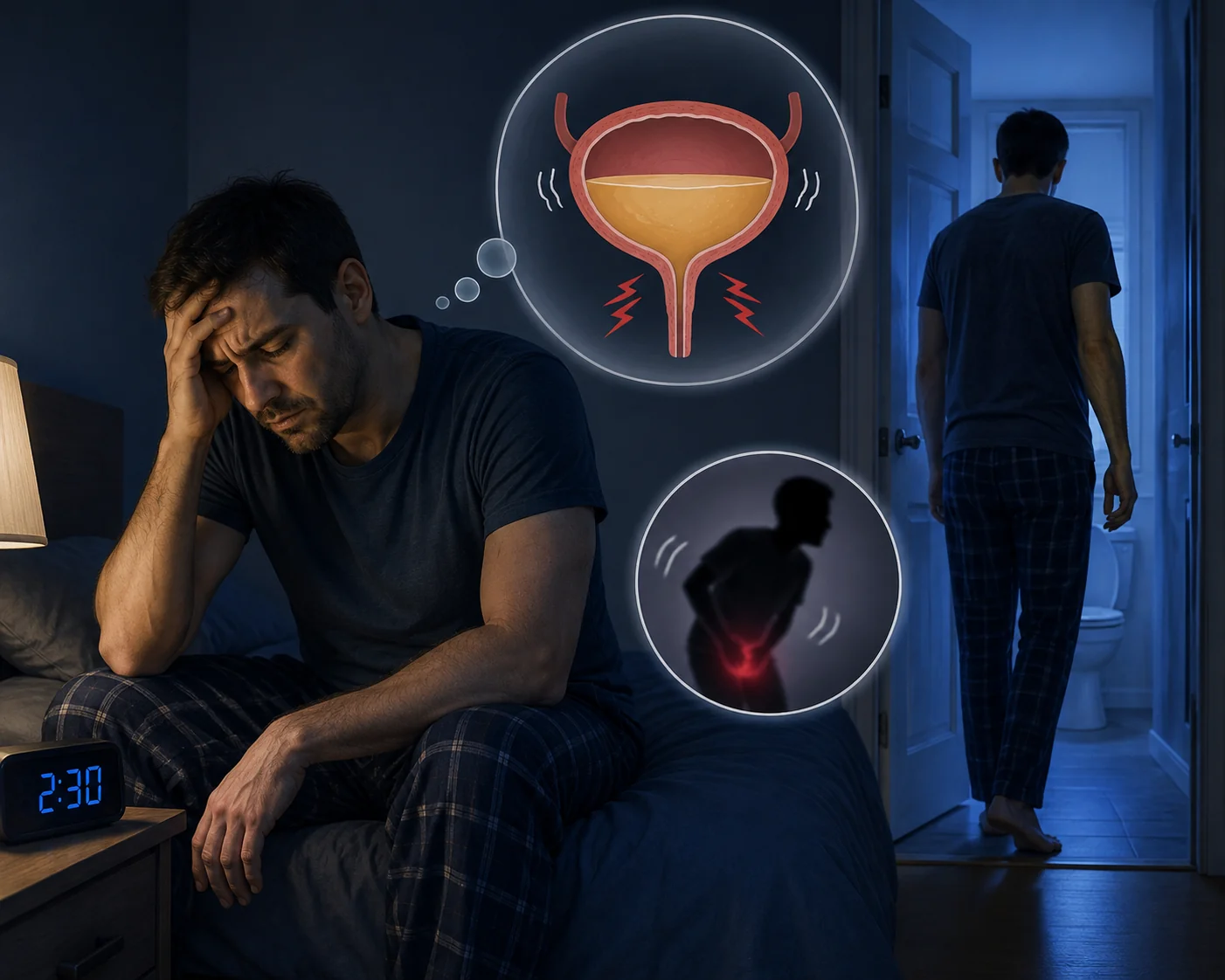
Test yourself with one question: Do you wake more than once a night to pass urine?
Many men get used to this and treat it as a normal effect of age.
It is usually the first symptom to appear, the most neglected, and the easiest to measure objectively in the clinic.
How we examine it here
We do not begin with treatment. We begin with numbers that describe your case precisely:
- Uroflowmetry
- The force of the urine stream and the degree of narrowing — it turns your complaint into a curve and a number. Duration: 20 minutes.
- Post-void residual measurement
- How much urine remains in the bladder after voiding — it reveals incomplete emptying. Measured within the same visit.
- Prostate volume measurement
- The actual size of the gland, not an estimate. Measured within the same visit.
- Cystoscopy
- Direct view of the passage and bladder where needed — as required.
- Urethral dilatation
- A therapeutic procedure where a confirmed narrowing exists — as required.
Which tests are usually requested?
The investigations describe the passage. The tests reveal what measurement cannot — and these are internationally standard in assessing this complaint:
- Urinalysis
- Always the first step. It rules out infection and blood before attributing symptoms to the prostate.
- Urine culture
- Where infection is suspected — it identifies the organism and the treatment that suits it, rather than trialling one.
- Kidney function
- Because prolonged urinary retention can affect the kidneys before the patient feels anything.
- HbA1c or fasting glucose
- Frequent night-time urination may be uncontrolled diabetes rather than an enlarged prostate. That distinction changes the treatment entirely.
- PSA blood test
- Discussed with the doctor according to your age and case, and its meaning explained to you before it is done rather than after.
A rule we hold to
Not every case needs every one of these tests. The doctor selects what your case requires after examination — this list is here so you know what may be asked of you, not so you can request all of it.
Attend emergency care or the clinic immediately if any of these occur
- Urine stops completely with fullness and lower abdominal pain — this is acute urinary retention.
- Blood appearing in the urine.
- A high temperature with lower back or lower abdominal pain.
- Severe, persistent pain while passing urine.
- Severe pain on one side extending to the lower abdomen.

Dr Mohammed Shaker Hito
Consultant Urological and Genital Surgeon
Medical Director, Hokamaa Najd Medical Complex
More than forty years of experience in urological and genital surgery — he began practising the specialty in 1984.
Holds German accreditation in his specialty.
Oversees the centre's approved medical service list as Medical Director; it is signed in his name.
Performs the diagnostic investigations himself in the clinic: uroflowmetry, post-void residual, prostate volume, cystoscopy, Doppler and the erection study.
Follows the case from examination through reading the result to the plan — patients are not passed between different hands inside the clinic.
This experience is what explains the clinic's approach: four decades in the specialty teach that most of what gets treated by guesswork could have been settled by a single investigation at the outset.
Questions and answers
Questions frequently asked about difficulty passing urine and enlarged prostate at the urology clinic at Hokamaa Najd.
No. Most cases of enlargement are entirely benign. But the symptoms are similar across different conditions, which is why it is examined rather than assumed.
No. You pass urine into a dedicated device in complete privacy, and the device records the flow automatically. Nothing is inserted and no anaesthetic is used.
Uroflowmetry takes twenty minutes in the clinic, usually accompanied by post-void residual measurement in the same visit.
Yes — arrive with a full bladder. Reception sends you the instructions with your appointment confirmation.
That is exactly what makes the investigation useful. A normal result rules out narrowing and directs the doctor towards another cause.
We tell you plainly and refer you to the appropriate provider. Honesty about the limits of our service is part of the care.

Book an examination appointment — we begin with measurement, not a prescription.
Book an Examination